
Under what circumstances might climate change lead to negative security outcomes? Over the past fifteen years, a rapidly growing applied field and research community on climate security has emerged. While much progress has been made, we still don’t have a clear understanding of why climate change might lead to violent conflict or humanitarian emergencies in some places and not others.
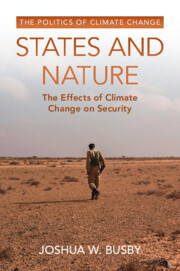
Busby develops a novel argument – based on the combination of state capacity, political exclusion, and international assistance – to explain why climate leads to especially bad security outcomes in some places but not others. This argument is then demonstrated through application to case studies from sub-Saharan Africa, the Middle East, and South Asia. This book will provide an informative resource for students and scholars of international relations and environmental studies, especially those working on security, conflict and climate change, on the emergent practice and study of this topic, and identifies where policy and research should be headed. [ dur: 38mins. ]
- Joshua Busby is a Professor of Public Affairs and a Distinguished Scholar at the Robert S. Strauss Center for International Security and Law. He is the author of State and Nature the effects of climate change on security ( The 2026 winner of the Grawemeyer Prize for Ideas Advancing World Order ) and many other publications.
With protests rocking Iran, how much are these protests historically consistent with the long history of protests in Iran. We explore this history in light of the new round of protests How much more violent has the Iran state been against protesters? [ dur: 20mins. ]
- Ervand Abrahamian is Professor Emeritus at City University of New York. He is the author of A History of Modern Iran and Inventing the Axis of Evil: The Truth About North Korea, Iran and Syria.
This program is produced by Doug Becker, Ankine Aghassian, Maria Armoudian, Anna Lapin and Sudd Dongre.
Climate Change, Human Rights, War / Weapons, Refugees, Bangladesh, India, Iran, Syria, Lebanon, Security
Podcast: Play in new window | Download
Subscribe: RSS